The Hill: the Redwood Library, Touro Park and the Old Stone Mill
Between the colonial town and the mansions, a quiet rise holds one of the oldest libraries in America and a round stone tower that has fed legends for two centuries.
Bellevue Avenue begins in the old town, climbs a gentle hill and only later becomes the avenue of mansions. That first stretch, around Touro Park, is one of the most pleasant hours in Newport: a library, a park, a museum, two church spires and a stone tower that nobody can quite stop talking about.
The Redwood Library
The Redwood Library and Athenaeum was founded in 1747 by a group of Newport men who wanted a library open to its members, with a gift of money from the merchant Abraham Redwood to buy books. The building, finished around 1750, was designed by Peter Harrison and looks like a small classical temple. Look closely at the front: what seems to be cut stone is wood, shaped and painted with sand in the paint to imitate masonry.
It is one of the oldest lending libraries in the United States still working in its original building. Inside are reading rooms, portraits and a collection that grew from the original books. Visitors are generally welcome to look around the public rooms during opening hours, which vary, so check before you go and keep your voice down; people are working there.
Touro Park
Across Bellevue Avenue lies Touro Park, a small green with old trees, paths and benches. It was named for Judah Touro, a son of the Touro Synagogue's first leader, who bought the land and left money for the town. A bronze statue in the park honours Commodore Matthew Perry, a Newport native remembered for his expedition to Japan in the 1850s.
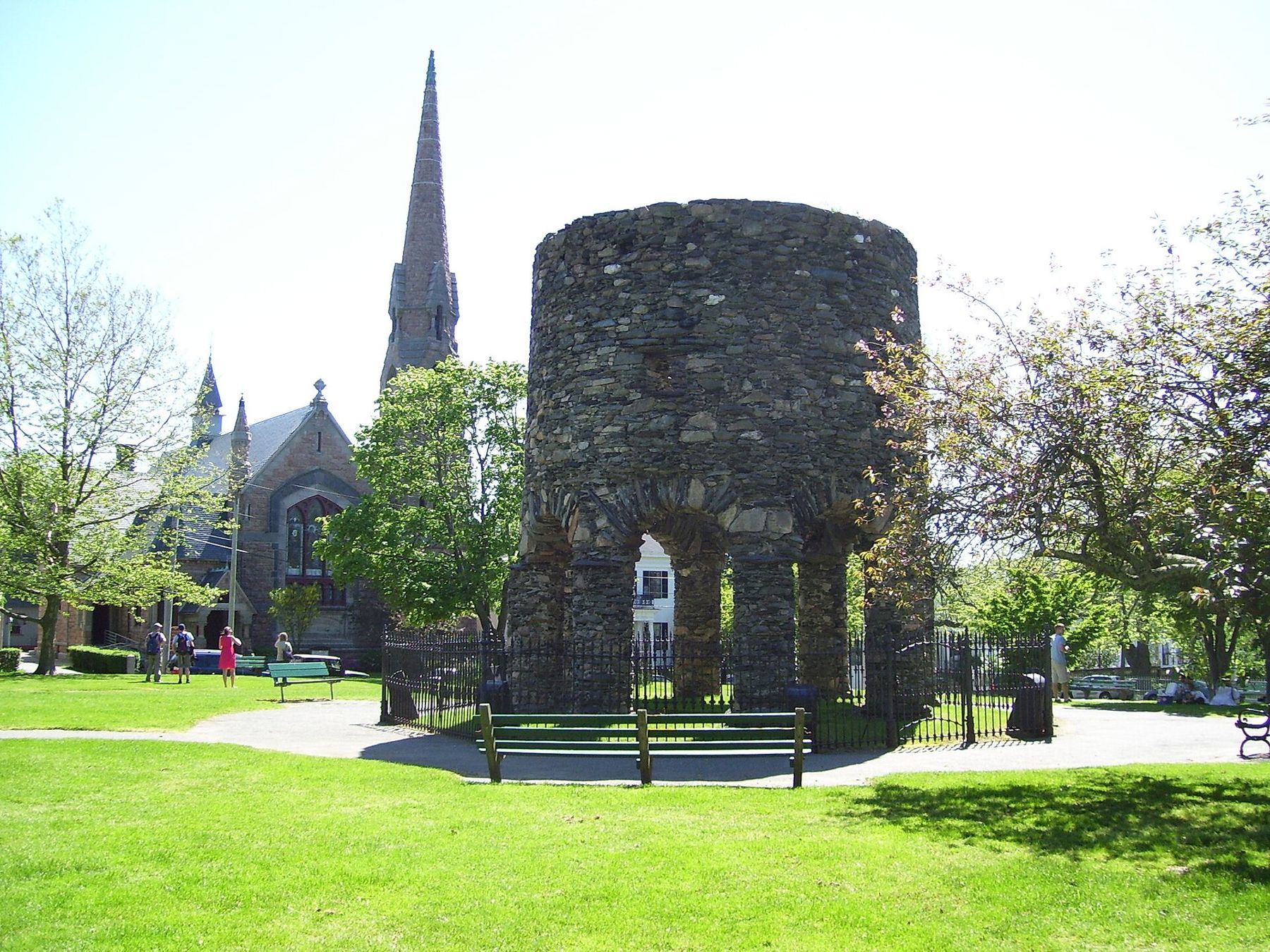
The park is the best place on the hill to sit for ten minutes. From the benches you can see the round stone tower, the library columns and, behind the trees, the spire of the Channing Memorial Church.
The Old Stone Mill
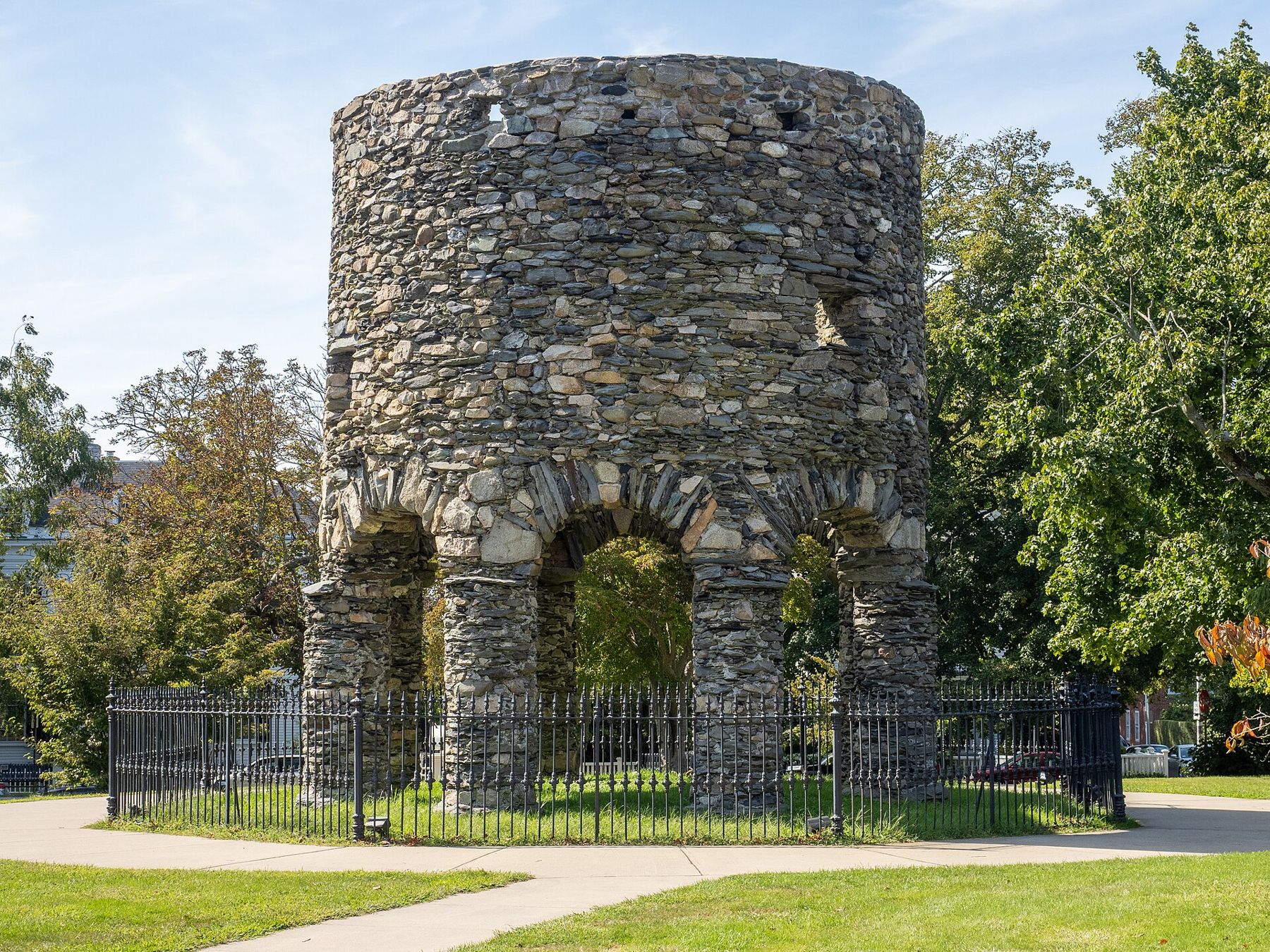
In the middle of the park stands the Newport Tower, usually called the Old Stone Mill: a round tower of rough stone set on eight arches, about eight metres high, roofless and fenced off. It is the oldest thing on the hill and the most argued over.
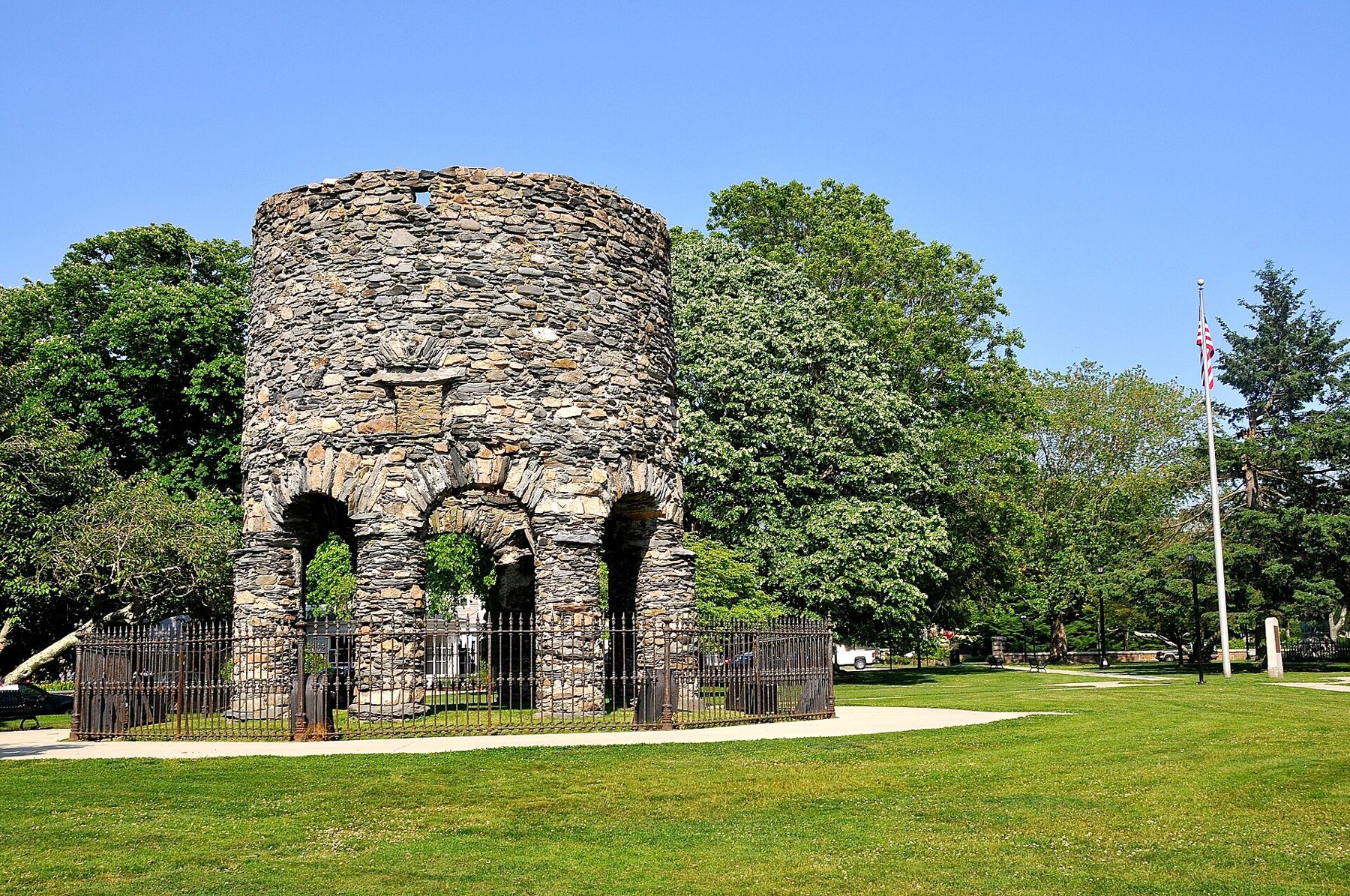
The mainstream view is that it was built in the seventeenth century as the base of a windmill for Benedict Arnold, the first governor of the Rhode Island colony under the 1663 charter and the great-grandfather of the later Revolutionary War general of the same name. Arnold's will of 1677 mentions "my stone built wind miln", and dating of the mortar points to the colonial period. Similar arched mills existed in England.
Also under flag PTouro Synagogue, Trinity Church and colonial NewportThe popular legend is different. Since the nineteenth century some have claimed the tower was built by Norse voyagers centuries before Columbus, or by other early visitors from Europe. These ideas have inspired poems, books and plenty of argument, but they are not supported by the archaeology. Enjoy the legend for what it is, and the tower for what it most likely was: the working heart of a colonial farm on the hill.
The art museum and the spires
A few steps along Bellevue Avenue is the Newport Art Museum, whose older building is a striking wooden house of the 1860s designed by Richard Morris Hunt, the architect who later built The Breakers and Marble House. The museum shows art connected with Newport and New England, with changing exhibitions; check opening days before you go.
The tall stone spire beside the park belongs to the Channing Memorial Church, named for William Ellery Channing, the Newport-born preacher who became a leading voice of American Unitarianism. Together with Trinity Church's white spire downhill, it marks the skyline of the old town.
From here, downhill or south
The hill sits between two Newports. Walk downhill along Touro Street or Mill Street and you reach the synagogue, Washington Square and the harbour, the heart of colonial Newport. Walk south along Bellevue Avenue and within a few blocks the houses grow larger, the lawns longer, and you are on the way to the summer cottages of the Gilded Age.
Colonial houses on the side streets
The streets that run off the hill toward the harbour, such as Mill Street, Church Street and School Street, keep a mix of colonial and nineteenth-century houses that is easy to overlook between the bigger sights. Some are plain eighteenth-century clapboard houses like those on the Point; others are Greek Revival and Victorian houses from the years when Newport was turning from a port into a resort. Walking down any of them toward Thames Street shows the town changing period by period in a few hundred steps.
This part of town is also full of small details: carved doorways, old fences, iron boot scrapers by the steps and street names that recall colonial families. None of it needs a ticket. It only needs a slower pace than most visitors give it.
A short visit done well
The hill is also a good starting point for longer walks, because nearly everything in old Newport is downhill from here. An hour is enough for the park, the tower and a look inside the library; add another hour for the museum. Street parking around the park is limited and metered in season. On a rainy day the library and the museum make this the best part of town to be in, and on a hot day the trees of Touro Park give shade that the shore does not.