Bellevue Avenue from end to end
A mile and a half of summer houses, built over seventy years, in roughly the order the money arrived. Read the avenue from north to south and the history makes sense.
Bellevue Avenue runs south from the middle of Newport toward the sea, ending where it turns west to become Ocean Drive. Along its length, and along the streets that branch off it toward the Cliff Walk, the summer families of the nineteenth and early twentieth centuries built houses that grew steadily larger, heavier and more expensive. Walk or ride it from north to south and you see the whole arc of the Newport summer colony, from Gothic Revival cottages to French palaces.
The northern end, near town
The avenue begins near Touro Park and the Redwood Library, in the part of town known as the Hill, which has its own story in The Hill and the Old Stone Mill. This end of Bellevue is still a town street: shops, the art museum, and the long shingled front of the Newport Casino, built in 1880 as a social club and now home to the International Tennis Hall of Fame. The first national tennis championships were played on its lawns.
Nearby is the Newport Art Museum, whose older building, the Griswold House of the 1860s, is an early wooden house by Richard Morris Hunt, with its timber framing patterned on the outside. Hunt worked in Newport for decades, from wooden houses like this one to marble palaces, and his career runs alongside the avenue itself.
A little farther on, set back on the west side, is Kingscote, a Gothic Revival house of about 1840. It was built when Newport's summer visitors came for the sea air and the society of a small town, and stayed in houses that would look modest a generation later. Kingscote and the slightly later Isaac Bell House, a Shingle Style house of the 1880s, are the subject of their own story.
Chateau-sur-Mer and the middle years
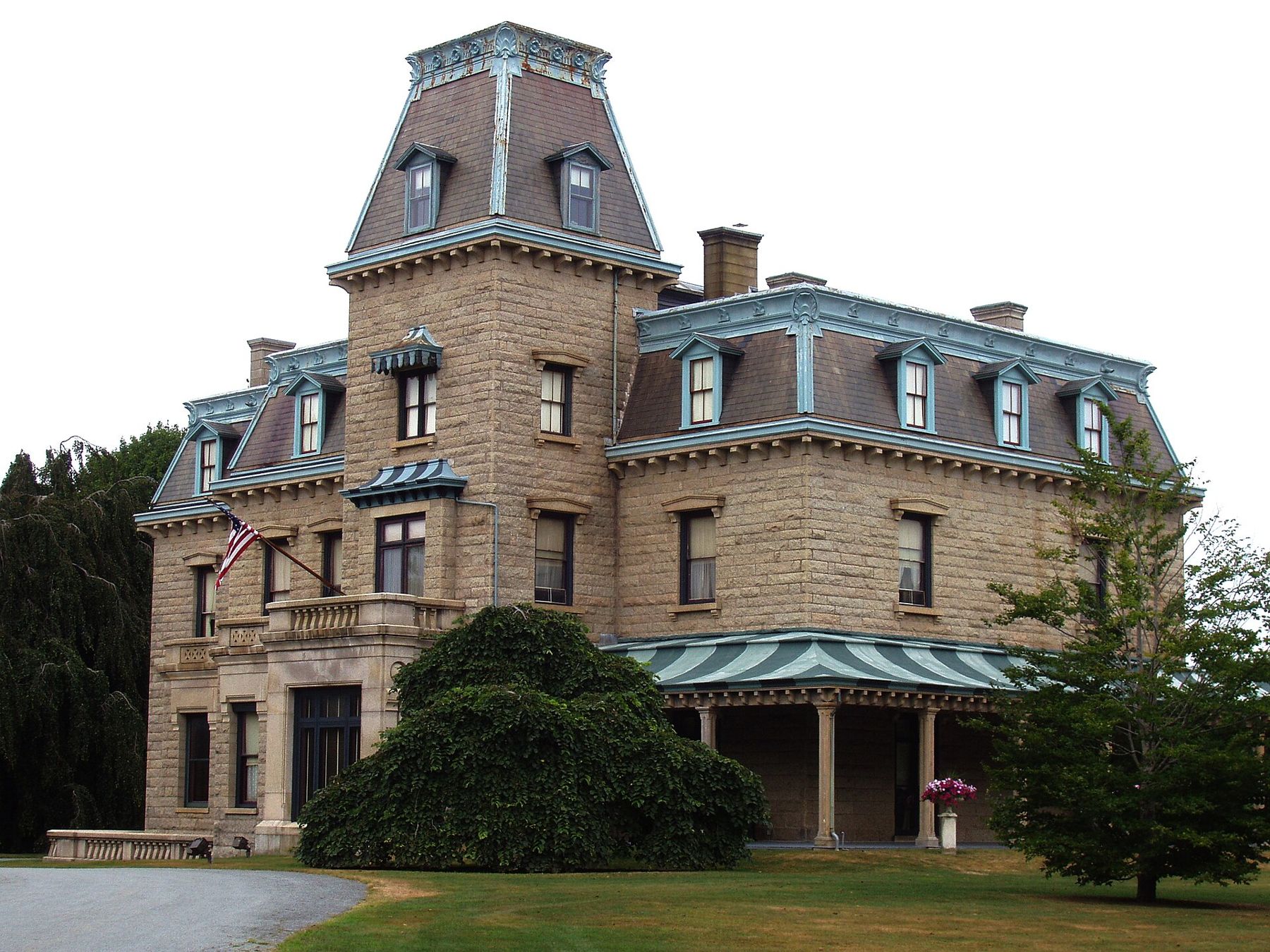
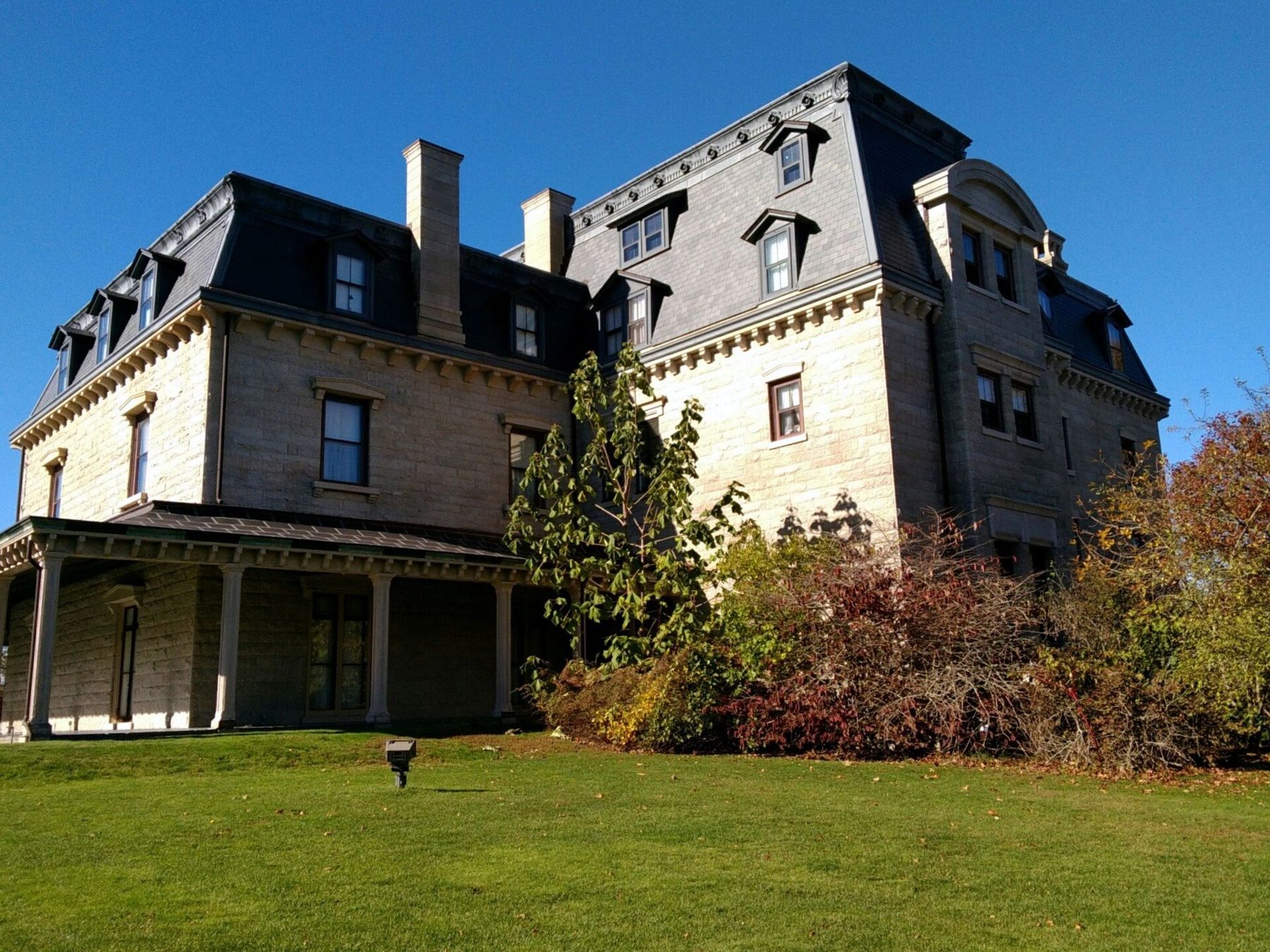
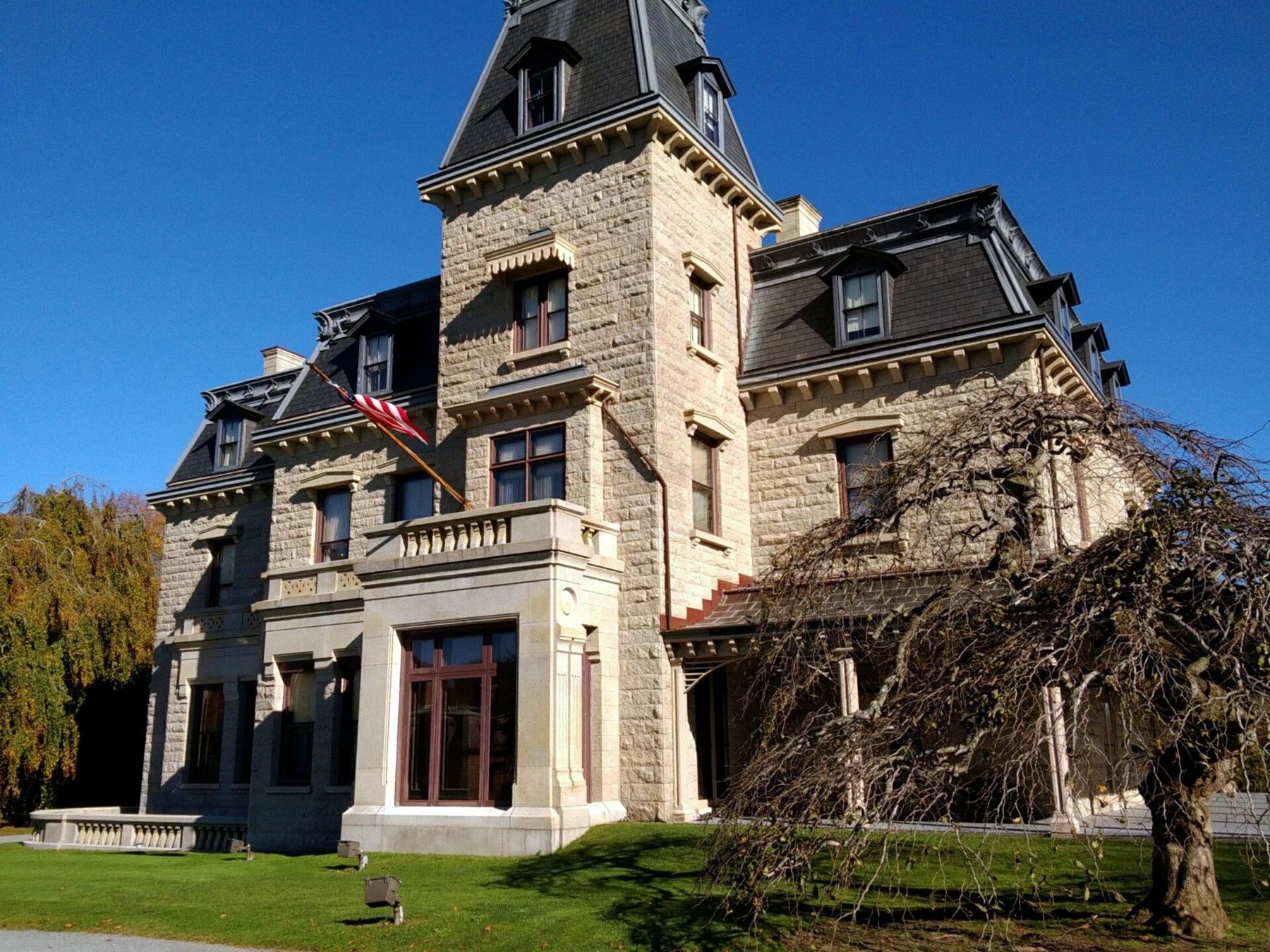
Chateau-sur-Mer stands on the east side of the avenue, behind a wall and a broad lawn. It was built in the early 1850s for William Shepard Wetmore, who had made his fortune in the China trade, and it was among the grandest houses in Newport in its day. In the 1870s his son had it enlarged and remodelled by Richard Morris Hunt, who gave it the high mansard roofs and the tower you see today.
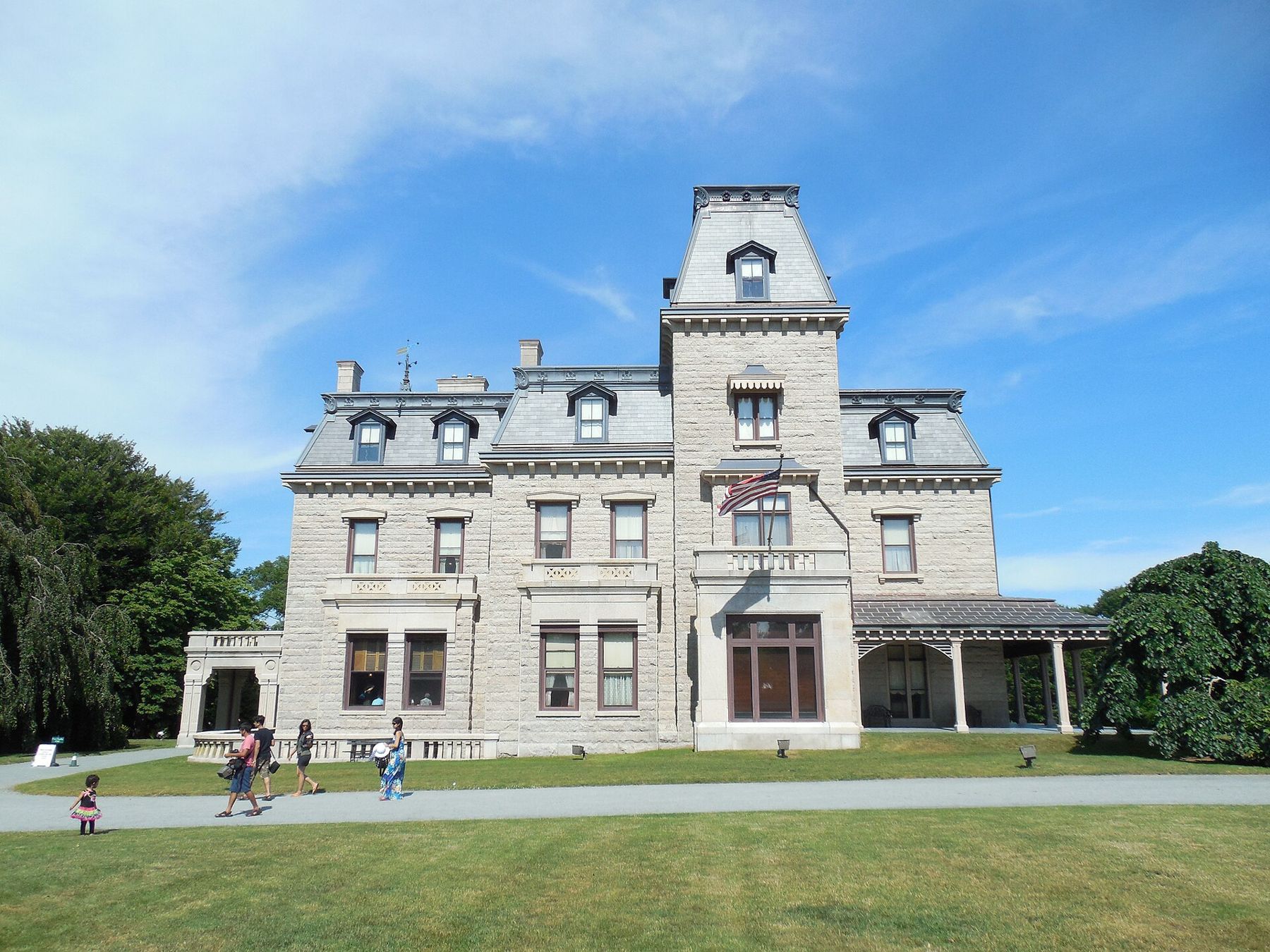
It is a heavy, dark-stoned Victorian house, more like a solid town mansion set in a park than the airy palaces that came later, and that is what makes it worth a visit. Inside, the rooms are full of carved wood and the furnishings of the 1870s and 1880s. The Preservation Society of Newport County has owned it since the late 1960s. On the Shepard Avenue side of the grounds a round stone moon gate, in the Chinese manner, opens in the boundary wall.
Families like the Wetmores came to Newport for the cooler summers and a social life busier than the countryside but quieter than New York. The early summer colony also drew writers, painters and scholars from Boston and New York, and the houses of the 1850s and 1860s show a taste for comfort and display that had not yet tipped into open competition.
Marble and money
From the 1880s the scale changed. The Vanderbilts and their circle arrived with railroad and industrial fortunes, and they hired architects who had trained in Paris to give them houses in the European styles. Richard Morris Hunt designed Marble House for William K. Vanderbilt and his wife Alva, finished in 1892, faced with white marble outside and in. Then came Belcourt, also by Hunt, for Oliver Belmont, and on a street off the avenue, overlooking the sea, The Breakers for Cornelius Vanderbilt II.
The houses that came after the 1880s were built to be seen, and many of them were used for only a few weeks each summer.Also under flag WMarble House and Rosecliff
Around 1900 came Rosecliff, designed by Stanford White on the model of the Grand Trianon at Versailles, and The Elms, built for the coal magnate Edward Julius Berwind after a French chateau of the eighteenth century. The houses that came after the 1880s were built to be seen, and many of them were used for only a few weeks each summer. Behind the facades were staff quarters, kitchens and service wings as large as many ordinary houses, and the people who worked in them, many of them immigrants, made the whole season possible.
Farther south the avenue grows quieter. Rough Point, Doris Duke's house on the shore, is now a museum. Beyond it are private houses behind hedges and gates, and the road finally bends west at Bailey's Beach.
The building boom did not last. The income tax, the First World War and later the Depression thinned the summer colony, and by the middle of the twentieth century several of the great houses stood empty or had been sold, and some were pulled down. The Preservation Society of Newport County, founded in the 1940s, began buying and opening houses to save them.
What you see from the road
Bellevue Avenue is a public road and you can walk, cycle or drive its whole length. What you see from it is mostly walls, gates, hedges and lawns, with houses set well back. Some, like Marble House and Rosecliff, are visible enough from the gate to give a good idea of them. Others reveal little, and you see their seaward faces better from the Cliff Walk below.
The sidewalks are narrow in places and the traffic in summer is steady, with tour coaches and cars slowing to look. A bike is pleasant early in the day. The avenue is long: from Touro Park to Bailey's Beach is a good walk, and you will want to come back a different way, either by the Cliff Walk or a side street.
Many houses along the avenue are private homes, still lived in, and the gates mean what they say.
How many houses to see
The Preservation Society of Newport County opens several of the houses to visitors, with a range of tickets for one house or several; Rough Point is run separately. Which houses are open, on which days and at what times changes with the season, and some close for the winter or open only for special events. Check before you go, and expect timed entry at the busiest houses in summer.
Two houses a day is plenty for most people, and one is often better. The interiors are dense with detail, and after the second gilded ballroom they begin to run together. A sensible pairing is one early house and one late: Chateau-sur-Mer or Kingscote for the Victorian summer colony, and Marble House, The Elms or The Breakers for the Gilded Age at full stretch. Seeing the two side by side makes plain how fast the money and the ambition grew.
If you have time for only one interior, choose by what interests you: Chateau-sur-Mer for Victorian design, Marble House for the story of Alva Vanderbilt, The Elms for its gardens and service rooms, The Breakers for sheer scale.
Leave time between visits to walk outside. The grounds of The Elms, with its formal gardens, and the lawns running to the sea at the houses on the Cliff Walk side are as much a part of the place as the rooms.