Marble House and Rosecliff
Two show houses a few gates apart on Bellevue Avenue, one built in marble for a Vanderbilt marriage that did not last, the other in white terracotta for a summer of dancing.
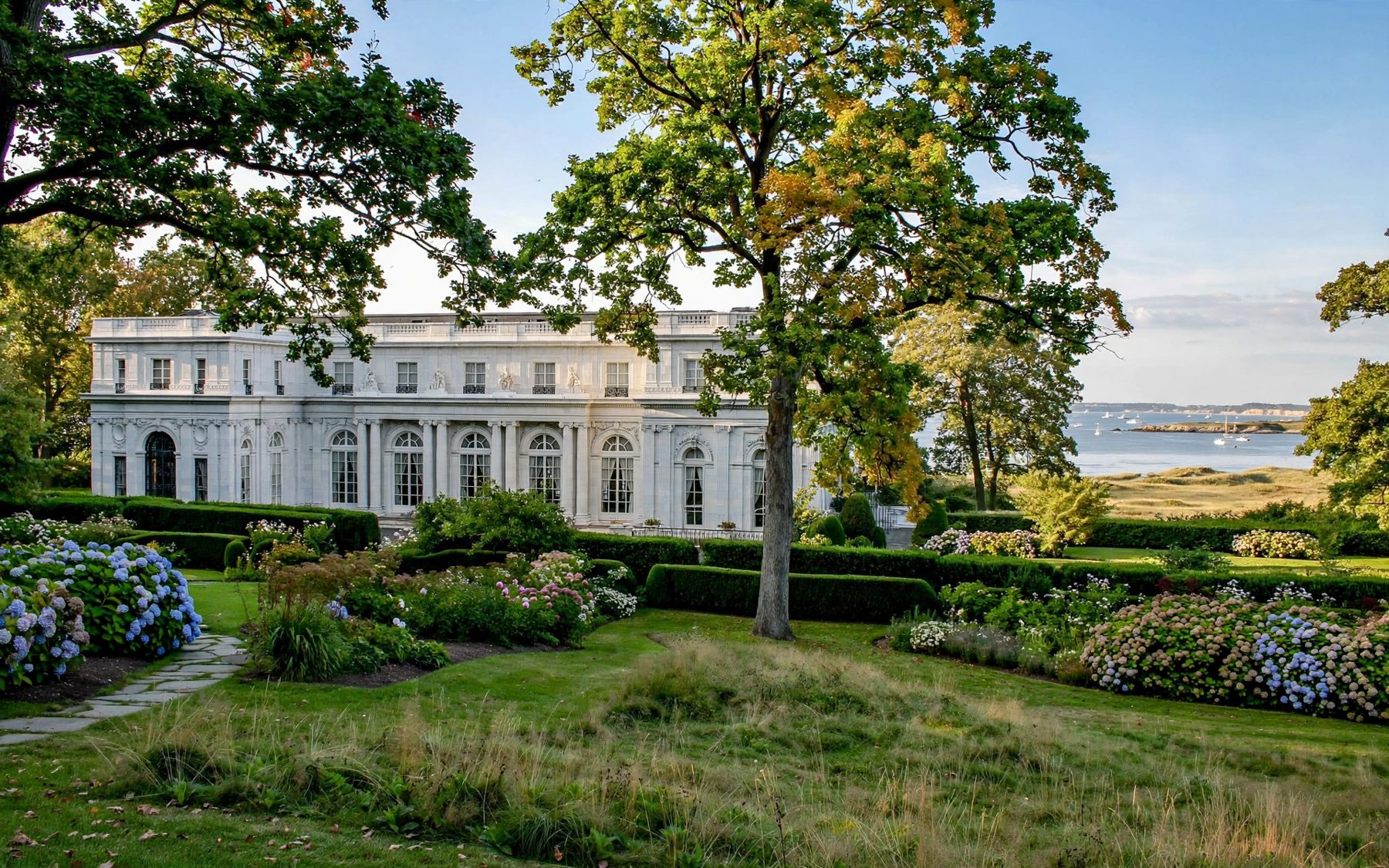
Marble House and Rosecliff stand a short walk apart on the ocean side of Bellevue Avenue, and they make the best pair of houses in Newport for a single day. Both were built to impress, both were built for entertaining, and both are now shown by the Preservation Society of Newport County. They are also different enough in mood that the second does not feel like a repeat of the first.
If you have already seen The Breakers, these two show the same age from another angle: one house shaped by a marriage and a divorce, the other by a hostess and her parties.
A marble house for Alva
Marble House was built between 1888 and 1892 for William K. Vanderbilt, a grandson of the Commodore, and his wife Alva. The architect was Richard Morris Hunt, who had trained in Paris and who did more than anyone to change the look of the avenue. The front, with its tall columns and white marble walls, draws on the classical buildings of eighteenth-century France, and the name is a plain description: marble was used outside and in, much of it shipped from Europe.
Alva Vanderbilt was the driving force behind the house. She had already pushed her way into New York society with a mansion on Fifth Avenue, and Marble House was meant to settle the question in Newport. It was a summer house in name, used for a few weeks a year, and a public statement in practice.
Gold, marble and the Gothic Room
Inside, the house is built for show rather than comfort. The entrance hall and staircase are lined with pale marble; the dining room uses a darker pink marble and heavy gilded bronze. The ballroom, usually called the Gold Room, is covered in carved and gilded wood and mirrors, and it is the room most visitors remember.
The Gothic Room is the surprise. It was made to show a collection of medieval and Renaissance objects, and its dark carved stone and pointed arches feel a world away from the gold next door. Upstairs, the bedrooms are lighter in tone. Rooms, routes and the way tours are run change from year to year, so check before you go.
Divorce, Belcourt and the return
William and Alva divorced in 1895, at a time when divorce in their circle was rare and scandalous. Alva kept Marble House. In the same year she pressed her daughter Consuelo into marriage with the Duke of Marlborough, a match Consuelo later described as forced on her and which also ended in divorce.
In 1896 Alva married Oliver Belmont, whose own house, Belcourt, stood a little way up the avenue. Marble House was closed for long stretches while she lived there. After Belmont's death in 1908 she came back to it, and the second part of the house's story began.
Also under flag WBellevue Avenue from end to endVotes for women on the lawn
In her later years Alva Belmont put her money and her energy into the campaign for women's suffrage. She founded a suffrage organisation in New York, funded the movement generously and opened Marble House for suffrage meetings and rallies, bringing speakers and supporters to the same lawns where society had once danced. She later led the National Woman's Party, which continued the fight for equal rights after the vote was won in 1920.
The house tells this story alongside the gilding, and it is worth giving it the same attention. Alva was demanding, often difficult and fully a member of her class, and she was also one of the movement's most important funders. Both are true, and the house holds both.
The Chinese Tea House
At the seaward edge of the lawn, close to the cliff, stands the Chinese Tea House that Alva added in the 1910s. It is a lacquered pavilion in red, green and gold, built in the taste for Chinese design that was fashionable at the time, and it was used for gatherings with the ocean as a backdrop. Its siting is the point: from the lawn you look past it straight out to sea.
You can see the tea house from the house grounds and, at close quarters, from the rough southern Cliff Walk below. Whether it is open, and what is served in it, varies by season.
Rosecliff and its ballroom
A few minutes north along the avenue, Rosecliff was completed around 1902 for Theresa Fair Oelrichs, whose father had made a fortune in Nevada silver. The architect was Stanford White, of the firm McKim, Mead & White, and he modelled the house on the Grand Trianon, the garden palace at Versailles. The walls are faced with white glazed terracotta rather than stone, which gives the house its soft, bright surface.
Rosecliff was designed around entertaining. Its ballroom is the largest of any house in Newport, with tall windows opening to the terrace and the lawn, so that on a summer night a party could spill out toward the sea. A staircase with a curving, heart-shaped turn rises from the hall, and it is one of the most photographed features of the house. Theresa Oelrichs was one of the leading hostesses of the summer colony, and the house was the stage for her balls.
The house has also been used as a film set, most famously for the 1974 version of The Great Gatsby, and it is still hired for weddings and events. Some rooms may be closed or set up for an event when you visit, which is one more reason to check before you go.
Seeing both in one day
Marble House rewards the longer visit, because of its rooms, its story and its tea house. Rosecliff is quicker, and its pleasure is the ballroom and the light on the lawn rather than room after room of detail. A sensible order is Marble House in the morning, a break, then Rosecliff in the afternoon.
The Preservation Society sells tickets for single houses and for combinations, and the houses keep different opening days and seasons, with some closing in winter. Parking is on the grounds or on nearby streets, depending on the house and the day. If you have energy left, walk down to the Cliff Walk behind them and see both seaward fronts from the path, the view their owners had in mind when they built.